




Reducing the total cost of ownership (TCO) has become a core focus for enterprises adopting artificial intelligence (AI). In today’s fast-paced digital landscape, executives are no longer impressed by how much technology a company can purchase — they care about how effectively it drives results. AI offers powerful advantages, but it can also drain budgets when poorly planned. The challenge is to maximize return on investment (ROI) while keeping expenses lean, scalable, and efficient.
Read More: Essential Command-Line Power Tools Every Data Scientist Must Master for Peak Performance
This article explores how organizations can optimize TCO during AI adoption, with a focus on large language models (LLMs), emerging enterprise AI trends, and the human factors that often determine success.
Understanding the Total Cost of Ownership (TCO)
TCO represents the full financial picture of implementing and maintaining a technology solution. It extends far beyond the initial purchase price, encompassing every cost associated with its lifecycle. For AI and LLM-driven platforms, these costs typically fall into three categories:
- Acquisition and Implementation – This includes purchasing hardware and software, setting up data centers, configuring systems, and integrating them into existing networks. Installation, electricity usage, and network infrastructure all add up quickly.
- Operations and Maintenance – Once the system runs, recurring costs follow: cloud subscriptions, GPU usage, API calls, model training, updates, and technical support. The more complex the AI solution, the higher these operational expenses become.
- Security and Human Factors – Downtime, inefficiencies, data leaks, and hallucinations can lead to hidden costs. Employee training, onboarding, and productivity losses due to steep learning curves also contribute significantly.
By understanding where ROI leaks occur, companies can focus on preventing inefficiencies rather than reacting to them.
Lessons from Early Cost Optimization
Over two decades ago, automation pioneers were already finding ways to optimize repetitive data tasks. Business intelligence (BI) analysts who could write code or design scripts often discovered shortcuts that saved their organizations both time and money.
For instance, replacing manual keyword analysis with an API-driven approach or switching from dashboard queries to Python scripts significantly boosted productivity. Automation didn’t just eliminate repetitive work — it fostered faster insights, tighter collaboration between marketing and IT, and better decision-making.
The lesson is timeless: employees who think like engineers and problem-solvers create value beyond their job titles. Yet many organizations still rely on outdated workflows. True innovation requires empowering staff to challenge inefficiencies and rewarding results rather than hours worked.
Sometimes, hiring an external consultant helps uncover hidden gaps that internal teams overlook. Innovation often comes from those willing to question established norms — and in AI, that mindset is priceless.
The Human Factor in AI Cost Management
Technology alone doesn’t determine the success of AI adoption — people and culture do. Across many enterprises, a “bigger is better” mentality persists: when a challenge arises, the instinct is to buy more tools, more servers, or more licenses. This mindset drives costs up without necessarily improving outcomes.
A mindset shift is essential. Organizations must learn to do better with less, involve their CFOs early, and align budgets with long-term value rather than short-term fixes.
Several human-driven barriers impact AI cost efficiency:
- Cultural Incentives: In some companies, career growth depends on managing bigger teams and budgets, discouraging lean innovation. Forward-thinking startups, however, achieve the same impact with far fewer resources.
- Investor Pressure: Executives often rush into expensive AI projects under investor demand, fearing they might fall behind competitors. Smarter investment, guided by data and clarity of purpose, yields far better ROI.
- Marketing Influence: Vendors offering free GPU credits or costly black-box models can trap companies into long-term dependence. A sustainable AI strategy requires understanding not only technology but also the business models behind it.
Smarter Hiring in the Age of AI
AI transformation demands talent — but not always the kind with the highest price tag. Many organizations compete to hire engineers from top AI labs, yet innovation often comes from less conventional candidates with curiosity and problem-solving skills.
Remote and international talent pools now offer incredible value. Instead of spending months navigating visa restrictions, companies can hire experts worldwide who deliver results from their home countries. AI can even assist in recruitment, screening candidates based on skills and creativity rather than credentials.
Forward-thinking employers also encourage exploration. Allowing staff to spend a portion of their time on experimental or “passion” projects can lead to groundbreaking discoveries. Many transformative ideas — from Einstein’s theories to modern AI breakthroughs — emerged from curiosity rather than assigned tasks.
Recognizing Inefficiencies in Today’s AI Ecosystem
Despite rapid progress, AI remains in its early stages. Many inefficiencies mirror the digital advertising boom of the early 2000s, where companies paid for “clicks” rather than real results. Today, AI vendors often charge by token usage, generating vast volumes of “garbage tokens” that don’t translate into value.
Enterprises must shift toward performance-based AI models, rewarding vendors based on accuracy, relevance, and business outcomes rather than volume.
Common inefficiencies include:
- Siloed Databases: LLMs fail to deliver complete insights when disconnected from crucial data sources. Bridging internal and external datasets is essential for context-rich responses.
- Weak Quality Assurance: Generating synthetic prompts and tracking user feedback helps identify blind spots and refine models.
- Over-Engineering: Massive 40-billion-parameter models are unnecessary when the dataset is small. More isn’t always better — it’s about the right size for the right task.
- Underutilized AI: Many users blame AI for poor code or confusing answers instead of iteratively refining prompts or guiding the system toward clarity.
In short, smarter AI use means designing for precision, not excess.
Key Elements for Technical Optimization
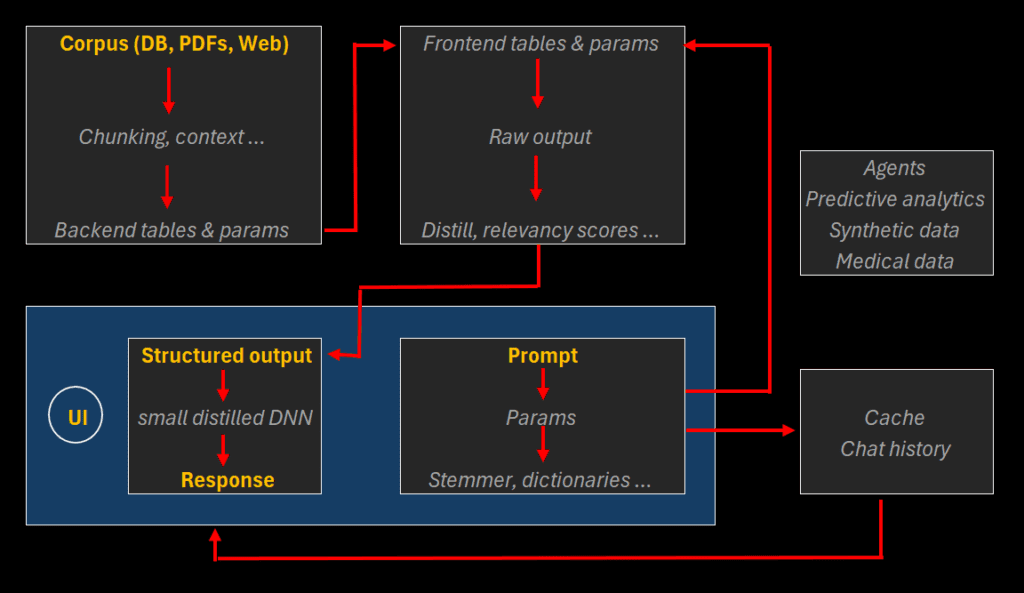
Efficient AI architecture dramatically reduces TCO. Whether building in-house or partnering with a vendor, the goal is to design systems that are fast, explainable, secure, and cost-effective.
- Hybrid RAG/SLM Models – Combining Retrieval-Augmented Generation (RAG) with Specialized Language Models (SLMs) produces structured, trustworthy outputs. Summarized responses with relevancy scores reduce hallucinations and eliminate prompt engineering needs.
- Compact DNNs and Distillation – Smaller deep neural networks trained on refined datasets maintain high accuracy while cutting computing and energy costs.
- Lightweight Infrastructure – Eliminating GPU dependence and reducing external API calls enhances security, shortens onboarding, and lowers electricity bills.
- Cache and Memory Optimization – Monitoring cache growth and memory leaks keeps systems efficient. Switching dynamically between CPU and GPU use balances performance and cost.
- Comprehensive Documentation – Indexed glossaries, version control, and clear code examples ensure reproducibility and faster debugging.
- Security and Compliance – On-premises deployment, access control at the corpus level, and explainable AI models protect organizations from liability. Data watermarking further secures proprietary information.
- Algorithmic Efficiency – Replacing O(n²) algorithms with O(n) when feasible and applying quantization techniques (e.g., 4-bit encoding) accelerate performance while reducing resource consumption.
Each of these technical measures directly contributes to leaner, greener, and more reliable AI systems.
Frequently Asked Questions:
What does ROI mean in the context of AI adoption?
ROI, or Return on Investment, measures the value a business gains from implementing AI technologies compared to the total cost spent. It reflects how efficiently AI tools enhance productivity, reduce expenses, and drive revenue growth.
How can AI help increase ROI for enterprises?
AI improves ROI by automating repetitive processes, optimizing decision-making, and revealing actionable insights from large datasets. It minimizes operational inefficiencies, enhances customer experience, and enables faster, data-driven outcomes.
What are the main cost factors affecting AI ROI?
Key cost drivers include hardware and software acquisition, data storage, cloud computing, and ongoing maintenance. Other hidden costs come from inefficient model training, poor data quality, and extended onboarding or downtime periods.
How can organizations reduce the total cost of ownership (TCO) in AI projects?
Companies can lower TCO by using compact AI models, adopting efficient RAG/SLM architectures, limiting GPU dependence, automating repetitive workflows, and ensuring better model explainability to avoid wasted resources and rework.
Why is data quality so critical to AI-driven ROI?
High-quality data ensures accurate model training and dependable predictions. Poor or incomplete data can lead to incorrect outcomes, reducing performance, increasing costs, and undermining the credibility of AI results.
What role do employees play in maximizing AI ROI?
Human expertise remains essential. Well-trained employees interpret AI outputs, identify inefficiencies, and innovate new use cases. Encouraging collaboration between technical and business teams helps ensure AI tools meet real organizational needs.
Are smaller, specialized AI models more cost-effective than large models?
Yes. Specialized or “small” language models (SLMs) often deliver faster, cheaper, and more accurate results for enterprise-specific tasks. They require fewer computing resources while maintaining high precision and security.
Conclusion
Maximizing ROI with AI isn’t just about adopting cutting-edge technology — it’s about adopting the right strategy. Enterprises that approach AI with a clear focus on efficiency, scalability, and human collaboration consistently outperform those that chase hype. By reducing the total cost of ownership, improving data quality, and investing in skilled talent, organizations can transform AI from an expense into a long-term growth engine. The path to success lies in building smarter, leaner, and more transparent AI systems that deliver measurable results — not someday, but in record time.
